Posts

Research Blog #10: Abstract and Works Cited

 Abstract The rise in popularity of paranormal media has been followed by a growth of paranormal belief throughout the twenty-first century. The gadgets used in paranormal media results in a scientific presentation of ghosts and paranormal existence. This paper explores how the technology-heavy representation of ghost-hunting tools in paranormal media misleads viewers into believing that ghosts can currently be scientifically proven with evidence like EMF and EVP. This paper also examines the factors behind viewers’ tendency to paranormal belief, such as the naturalizing effect, the public’s lack of scientific understanding, and social influence.  Works Cited (Note: Formatting may be odd on Blogger despite my attempts at reformatting) Axtell, Cassie C., "Assessing Electronic Voice Phenomena through Speech Science"  (2017).   Honors Theses . 415. https://encompass.eku.edu/honors_theses/415 Buckner V, John E., and Rebecca Anders Buckner. “Talking to the Dead, Listening...

Literature Review #5

Image
Here is a picture of what is marketed as a “Premium Ghost Hunting Digital EVP Recorder” on Amazon. Upon closer inspection, this product is just an ordinary digital voice recorder. https://www.amazon.com/Premium-Ghost-Hunting-Digital-Recorder/dp/B0888V7B9H Axtell, Cassie C., "Assessing Electronic Voice Phenomena through Speech Science."       Honors Theses, Encompass, 2017, https://encompass.eku.edu/honors_theses/415 Axtell explores some of the history behind EVPs and analyzes the reliability of using EVPs as a method for ghosts to communicate with humans. She mentions examples of different experiments that show how interpretations of EVPs vary significantly between people, which indicates that EVP interpretations may not be accurate at all. She also applies the possibilities of apophenia and priming to ghost hunting and EVPs. Axtell further laments the lack of speech scientists and speech analysis during EVP interpretations; thus, all that ghost hunters have are...

Research Blog #9: Argument and Counterargument

This is my argument: The use of gadgets like EMF (electromagnetic frequency) readers and audio recorders to capture EVPs (electronic voice phenomenon) allows ghost hunters to falsely present their findings as scientific, and the prominence of paranormal media reinforces this misunderstanding. This representation of ghost-hunting technologies, as a result of the “naturalizing” effect, incorrectly legitimizes paranormal investigations and tricks people into trusting the flimsy evidence that such technologies provide. The general public’s lack of scientific understanding makes them susceptible to this misconception, thus perpetuating a belief in paranormal existence.  These are my research questions: In what ways do ghost hunting technologies falsely legitimize the scientific aspect of the paranormal? How does the media (i.e., paranormal programming) perpetuate these misunderstandings? Ghost hunting technologies make the paranormal seem scientific as a result of the “naturalizing” eff...

Research Blog #8: Case

Image
 The chief example I use to illustrate my argument and explain my frame is the episode of Ghost Hunters that I watched (season 8 episode 11, “The Princess and the EVP”).  In this episode, the Ghost Hunters visited a supposedly haunted hotel called the Omni Mount Washington Resort. The Ghost Hunters then proceeded to set up their ghost-hunting gadgets and jumped at every faint sound or movement out of the corner of their eyes, despite their logical explanations about why they might see movement due to the room designs or why they might hear sounds due to the weather and architecture. They even acknowledged that EMF meters are prone to false positives. However, the Ghost Hunters still used their gadgets to legitimize their investigation to themselves and their viewers. This illustrates my frame of the “naturalizing” effect, which asserts that the use of scientific jargon and complicated-looking technology falsely convinces people into confusing fake science with actual science....

Research Blog #7: Theoretical Frame

I am using the theory of the “naturalizing” effect and the academic concept of social influence to help me analyze and explain my project. My questions are: In what ways do ghost hunting technologies falsely legitimize the scientific aspect of the paranormal? How does the media (i.e., paranormal programming) perpetuate these misunderstandings? The theory of the “naturalizing” effect suggests that presenting inaccurate information in a convoluted scientific manner tricks people into thinking that the inaccurate information is actually correct and just scientific but difficult to understand. This theory can be applied to show that by presenting ghost hunting technologies as scientific, the media misleads viewers into believing that such technologies are actually scientific when they are not. The "naturalizing" effect was proposed by Dr. David Kirby, a professor of science communication from the University of Manchester. Kirby applies this theory to science fiction, but for my p...

Literature Review #4

Image
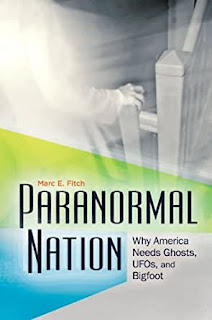
Fitch, Marc E.. Paranormal Nation: Why America Needs Ghosts, UFOs, and Bigfoot,   ABC-      CLIO, LLC, 2013. ProQuest Ebook Central, http://ebookcentral.proquest.com/lib/rutgers-      ebooks/detail.action?docID=1183924.      I mainly focused on Chapter 7, “The Rise of Paranormal Television.” This chapter talks about the popularity of paranormal programming. In this chapter, Fitch suggests that people are drawn to paranormal programming because they are fascinated by the conflict and mystery between science and the paranormal. He talks about how the balance between science and the paranormal is essential in paranormal television because actually proving the existence of the paranormal would lead to an end in such programming, but only showing the scientific side (i.e., that the paranormal does not exist) would make television less entertaining. Fitch further argues that science does not stand a chance when faced with paranormal programmin...

Research Blog #6: Visual

Image
     This is a visual that I put together from How Stuff Works (Link: https://science.howstuffworks.com/science-vs-myth/afterlife/evp.htm). This image shows the major steps of analyzing EVPs, according to the Ghost Investigators Society. The first screen shows the unedited voice pattern, the second screen shows the wave form statistics used to analyze the pattern, and the third screen shows the analysis graph, which helps the investigators determine whether or not the voice sample was actually EVP. This visual actually helps to illustrate the counterargument, as it shows the “scientific” part of EVPs. After discussing this visual and how recorded voice patterns are checked before being deemed as actual EVPs, I would like to discuss how all the actual interpretation of EVPs is still up to humans, who are very much fallible and are likely to hear words out of nonsense. 

Research Blog #5

  Research questions: Why do paranormal investigators use the tools that they use? How does the media (i.e., paranormal programming) affect the choices and beliefs of investigators and observers? Why are some people more likely to believe in the paranormal than others? Works Cited Axtell, Cassie C., "Assessing Electronic Voice Phenomena through Speech Science" (2017).  Honors Theses. 415. https://encompass.eku.edu/honors_theses/415. Aykroyd, Peter H., and Angela Narth. A History of Ghosts: the True Story of Séances, Mediums,  Ghosts, and Ghostbusters . Rodale, 2009.  Blum, Deborah. Ghost Hunters: William James and the Search for Scientific Proof of Life after  Death . Century, 2007.  Brewer, Paul R. “The Trappings of Science: Media Messages, Scientific Authority, and Beliefs  About Paranormal Investigators.” Science Communication , vol. 35, no. 3, SAGE  Publications, 2013, pp. 311–33, doi:10.1177/1075547012454599. Fitch, Marc E.. Paranormal Nat...

Literature Review #3

Image
 “‘Sheet Happens!’ Advancing Ghost Studies in the Analytics Age” by James Houran Image of James Houran, found on ResearchGate Houran, James. “‘Sheet Happens!’ Advancing Ghost Studies in the Analytics Age.”       Australian  Journal of Parapsychology , vol. 17, no. 2, Dec. 2017, pp. 187–206.       EBSCOhost,  search.ebscohost.com/login.aspx?      direct=true&db=aph&AN=127093363&site=ehost-live. (Link: https://login.proxy.libraries.rutgers.edu/login?url=https://search.ebscohost.com/login.aspx?direct=true&db=aph&AN=127093363&site=ehost-live)      This paper discusses many of the issues with modern-day ghost studies, such as an over-reliance on gadgets, and proposes a possible solution in order to advance ghost studies.       James Houran is a parapsychologist. He also has a Master’s Degree in Clinical Psychology from the University of Illinois at Springfield (USA...

Literature Review #2

Image
“Magic and Memory: Using Conjuring to Explore  the Effects  of Suggestion, Social Influence, and Paranormal Belief on Eyewitness  Testimony for an Ostensibly  Paranormal Event” by Krissy Wilson and Christopher C. French Image of Christopher C. French, found on Wikipedia Wilson, Krissy, and Christopher C. French. “Magic and Memory: Using Conjuring to Explore       the Effects  of Suggestion, Social Influence, and Paranormal Belief on Eyewitness       Testimony for an Ostensibly  Paranormal Event.” Frontiers in Psychology, vol. 5,       FRONTIERS RESEARCH FOUNDATION, 2014,   pp. 1289–1289,       doi:10.3389/fpsyg.2014.01289. (Link: https://bit.ly/37s1Raq)      Researchers exposed participants to fake psychics and asked them to complete a questionnaire about what they witnessed. Participants were exposed to different types of social influences (negative, positi...

Research Proposal

Working Title: The Effect of Cognitive Ability and Scientific Misrepresentation on Paranormal Belief Topic :       I will examine the possible reasons behind people’s continued belief in the paranormal. This paper will link people’s cognitive ability to scientific misrepresentation, particularly in media, and explore the unreliability of ghost-hunting techniques, such as EVP.  Research Question:       What sparked people’s interest in contacting spirits? How have our methods of reaching the undead evolved, and are these methods reliable? Despite the mounting evidence against the existence of spirits, why do people continue to believe in the paranormal? Theoretical Frame: In the study by Gordon Pennycook et al. “Analytic Cognitive Style Predicts Religious and Paranormal Belief,” and the study “Probability Misjudgment, Cognitive Ability, and Belief in the Paranormal” by Jochen Musch et al., researchers looked into the link between people’s c...

Literature Review #1

Image
"Analytic Cognitive Style Predicts Religious and Paranormal Belief" by Gordon Pennycook et al. (Image of Gordon Pennycook, found on Twitter) Pennycook, Gordon, et al. “Analytic Cognitive Style Predicts Religious and Paranormal       Belief.”  Cognition , vol. 123, no. 3, Elsevier B.V, 2012, pp. 335–46,       doi:10.1016/j.cognition.2012.03.003. (Link: https://bit.ly/3bk2i7H )      The purpose of this study was to find whether or not people’s cognitive abilities are correlated with their religious and paranormal belief. In the end, the researchers established that there was indeed an association between these variables.       Gordon Pennycook is an assistant professor of behavioral science at the University of Regina. His research is primarily focused on reasoning, judgement, misinformation, and beliefs. Pennycook has a PhD from the University of Waterloo and completed his postdoc at Yale University’s departm...

Research Question and 3 Scholarly Sources

What sparked people’s interest in contacting spirits? How have our methods of reaching the undead evolved, and are these methods reliable? Despite the mounting evidence against the existence of spirits, why do people continue to believe in ghosts? Musch, Jochen, and Katja Ehrenberg. "Probability Misjudgment, Cognitive Ability, and       Belief in the Paranormal." British Journal of Psychology, vol. 93, 2002, pp. 169-77.       ProQuest, https://login.proxy.libraries.rutgers.edu/login?url=?url=https://www-proquest-      com.proxy.libraries.rutgers.edu/scholarly-journals/probability-misjudgment-cognitive-      ability-belief/docview/199588868/se-2?    accountid=13626, doi:http://dx.doi.org.proxy.libraries.rutgers.edu/10.1348/0007126021625      7. Pennycook, Gordon, et al. “Analytic Cognitive Style Predicts Religious and Paranormal       Belief.”  Cognition...

Scouting the Territory

    I'd like to mostly keep my original topic but focus more on the history of séances and the occult (possibly just in America, but I'm not entirely certain for now). I'd also like to talk about why people seem to be so fascinated with the idea of ghosts and contacting the dead. I still think it would be interesting to further explore more "modern" and "scientific" ways of contacting spirits today as well; however, after looking into the topic some more, I think I will end up discussing actual scientific explanations for why people think they see ghosts as well as the reasons for why different technologies used to detect or contact ghosts actually prove nothing. Originally, I wanted to touch on both sides of the "Are ghosts real?" argument, but after doing some further research, it would be far easier for me to explain why ghosts do not exist, as I am now thoroughly a skeptic. Thinking ahead, I think I'd like to open my paper with the hist...

Topics for Consideration

Image
     The topic that I am considering right now is ghosts. To be more specific, I would like to explore some well-known or documented cases of human contact with spirits and then examine some of the methods that people use to communicate with the dead. For example, I'd like to further research the history or (pseudo)science behind spirit boxes, oujia boards, and séances. How do these methods work, and why do we place our faith in them?      I've always been intrigued by ghost stories. I love horror movies and think that stories of encounters with paranormal entities are absolutely fascinating. However, as a skeptic, I always tend to question the things I hear regarding the supernatural. Still, there are some pretty exciting stories about ghost sightings or hauntings that I would love to look into, even if I don't necessarily believe in ghosts. I'd also like to find out more about why "scientific" evidence of ghosts is deemed "scientific"--what makes p...